

I’m Rebecca Overton, Senior Design Manager and Structural Engineer at ChangeMaker 3D.
I’ve designed all of our water infrastructure assets to date and overseen designs through onsite delivery using our Printfrastructure Hubs.
Standing next to something you’ve designed while it is being printed gives you a slightly different perspective on 3D concrete printing. The printer is impressive, of course, but as an engineer I am looking past the machine. I am thinking about material behaviour, load paths, buildability and safety.
The material itself is not the radical part. It is concrete, after all. We know concrete, and we should not be frightened of it.
The mix has to be engineered for the printing process. It must be pumpable and extrudable, then develop enough stiffness and strength to retain its shape and support the layers above. Layer interfaces, early-age behaviour and direction-dependent properties all need to be understood.
Those differences matter, but they do not place printed concrete outside structural engineering. They give us a particular set of behaviours to characterise, test and incorporate into the design. That is familiar territory for engineers.
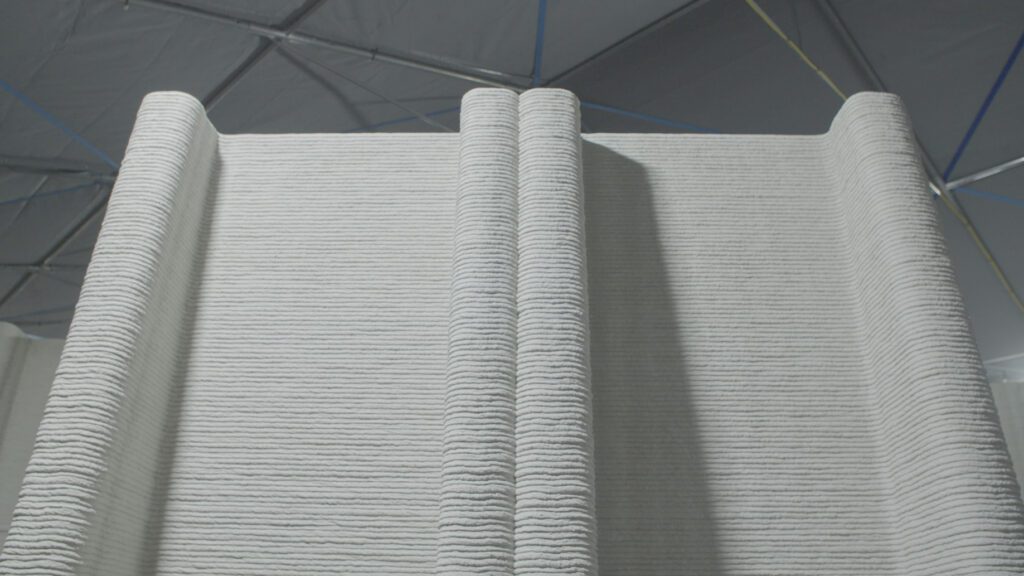
Geometry is the engineering opportunity
Where 3D concrete printing becomes genuinely exciting is geometry.
Engineers have used geometry to make the best use of materials for thousands of years. Roman aqueduct arcades used repeated arches to carry water across valleys. Brick tunnels use curved, vaulted forms to keep masonry working predominantly in compression. In each case, the geometry responds to the strengths and limitations of the material.
Concrete construction has also been shaped by how we build it. Conventional formwork tends to favour straight walls, constant sections and repeatable details because they are practical to form, reinforce and pour.
Remove that formwork and geometry becomes a much freer design variable. Wall thickness can vary with demand. Curves, ribs, voids and cellular forms become practical to manufacture. Material can be placed where it is doing useful work rather than simply where a uniform mould dictates.
I am not interested in complicated geometry for its own sake. The question is whether geometry can deliver the required structural performance with less material, simpler construction or a better whole-life outcome.
That is not a new engineering question. What is new is having a manufacturing process that lets us answer it differently.
Why this matters to me
I originally went into engineering because I wanted to work in international development and humanitarian aid. Life and circumstance took me along a different route, and I discovered a real love of refurbishing historic buildings, which remains the other major part of my day-to-day work.
That work has shaped how I approach 3D printed concrete. Historic structures show how effectively engineers and craftspeople used geometry to work with the material available to them. Masonry arches, vaults and brick tunnels keep materials working predominantly in compression. Seeing that first-hand has made me approach printed concrete as a compression-first material and think carefully about how its geometry can make the most of that strength.
3D printing also gives me a route back to the reason I chose engineering in the first place. Through Printfrastructure™, we have already worked with United Utilities and Scottish Water on printed infrastructure for the water sector. Our current work with Northumbrian Water Group is exploring the route towards clean-water assets, including a printed water-storage reservoir.
The need is substantial. UNICEF’s latest global monitoring found that 2.1 billion people still lacked safely managed drinking water in 2024. WaterAid also highlights the particular difficulty and cost of getting construction materials, parts and skilled labour to remote communities.
3D printing will not solve the political, financial and maintenance challenges around water provision on its own. It does, however, create a real opportunity to manufacture infrastructure more flexibly, potentially closer to where it is needed, and to adapt components for very different locations. For me, that possibility is both technically exciting and personally meaningful.
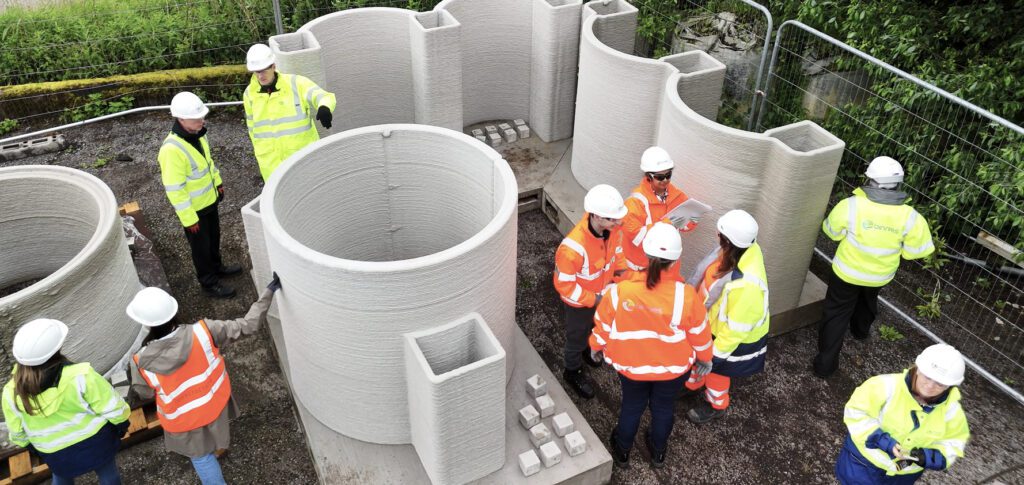
Using less material
The same focus on geometry matters for embodied carbon. All engineers should now be treating embodied carbon as a design consideration, not an optional extra.
For a period, much of the industry’s attention settled on specifying high levels of cement replacement as the answer to lower-carbon concrete. Mix design and lower-carbon binders matter, but they are only part of the answer. Secondary cementitious materials are also a constrained resource, so simply specifying more of them everywhere is not a complete carbon strategy.
The Institution of Structural Engineers identifies reducing concrete volume, reducing cement content and moving to lower-carbon cements as the three main routes to reducing emissions from concrete. The first of those is where geometry can make a substantial difference.
If the print geometry allows us to place material only where it is structurally required, we can reduce the total volume of concrete rather than only reducing the carbon intensity of each cubic metre. That can provide substantial embodied-carbon reductions and, because there is less material to buy, move and handle, worthwhile cost savings as well.
Those benefits will always be project-specific and need to be demonstrated through design, carbon assessment and cost analysis. But structural efficiency should be the starting point: use the material well, use less of it where we safely can, and then optimise the material specification.
First principles and engineering assurance
One of the things I enjoy most about this work is that it takes structural engineers back to first principles. What is the structure actually doing? Where are the loads going? Where is material needed, and where is it not? What governs the design? What evidence is needed to demonstrate that it is safe?
The printer does not replace those questions, and it certainly does not replace engineering judgement.
Eurocode 2 and the relevant British Standards do not become irrelevant because a robot is placing the material. Ultimate and serviceability limit states still matter. So do stability, durability, crack control, reinforcement, interfaces and design life.
The task is to bring the characteristics of the printed system into that established engineering framework. Where existing standards do not directly answer a question, we identify the gap and generate the evidence needed to address it.
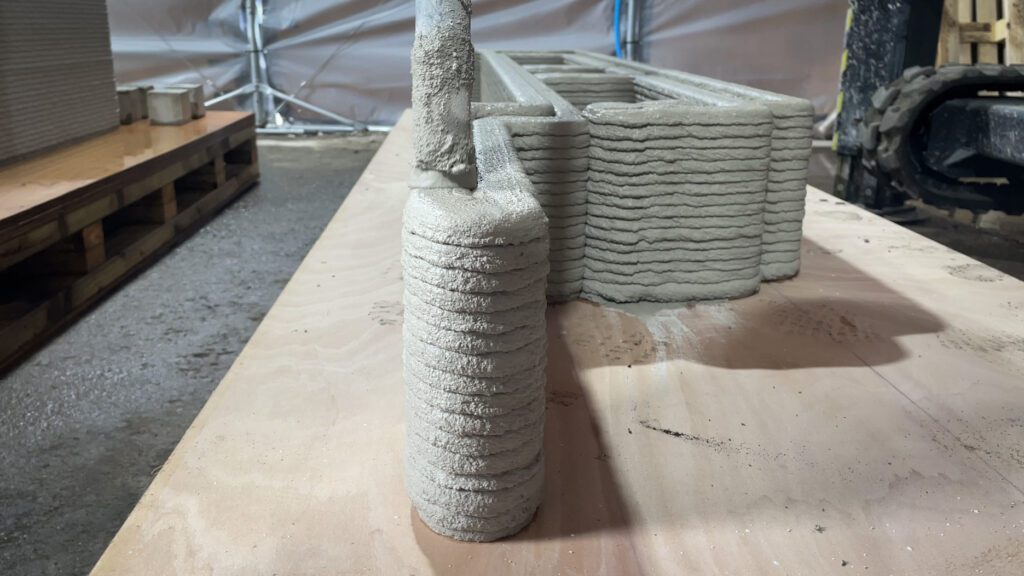
My approach to design safety comes back to three principles:
1 Understand the load path before the print path
Start with structural behaviour, not with what the printer can do. The geometry should respond to the engineering requirement.
2 Design the construction condition as well as the finished structure
A printed structure passes through several states before it becomes the asset shown on the final drawing. We need to understand early-age strength, layer build-up, temporary stability, reinforcement installation, interfaces, lifting, handling and the sequence through which the asset reaches its final condition.
3 Test uncertainty rather than designing around it
If the manufacturing process introduces something that is not adequately addressed by existing guidance, we identify it and decide what material characterisation, analysis, testing, inspection or validation is required.
Innovation does not mean reducing engineering assurance. It means doing the work needed to apply that assurance to a different method of manufacture.
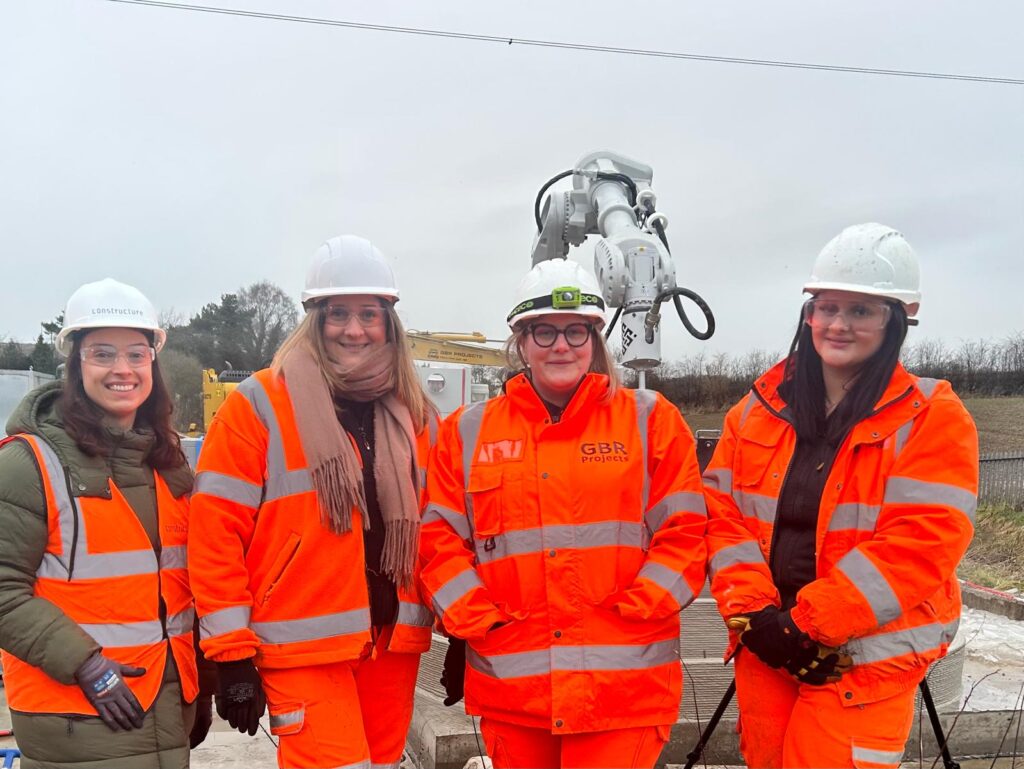
Why diverse teams matter
There is also a more personal aspect to this for me. As far as we are aware, I am currently the only woman structural engineer in the UK leading the design of 3D concrete printed infrastructure assets. I am proud of that, but I would also quite like not to be the only one.
EngineeringUK reports that women make up just 17% of the UK’s engineering and technology workforce. That is a great deal of talent and perspective that the profession is still failing to attract and retain.
This is not only a question of representation. The Royal Academy of Engineering has drawn together evidence linking inclusive teams with stronger performance, innovation, recruitment and retention. Its research also found that engineers who feel included are more confident speaking up about improvements, mistakes and safety concerns.
That matters in a developing field. If people with different experiences and ways of thinking come at the same problem from different angles, they ask different questions, challenge different assumptions and spot different risks and opportunities.
The codes, evidence requirements and safety thresholds do not change depending on who is in the room. The quality of the thinking around them can.
I want more women in engineering, and I want a broader range of engineers shaping 3D concrete printing while its methods and norms are still developing. A more diverse profession gives us a larger talent pool and a better chance of finding the strongest solutions.
What structural engineers can bring
3D concrete printing should not belong only to roboticists or technology companies. Engineers need to be actively involved in deciding how it is used, evidenced and developed.
We are not discarding the principles that structural engineering has developed over generations. We are applying them to a manufacturing process that removes some familiar constraints and gives geometry a larger role in the solution.
For me, that is the exciting part: familiar materials, sound engineering principles and new freedom to shape the structure around what it actually needs to do.
So I would be interested to ask other designers and engineers:
If formwork and conventional geometry were no longer your starting constraints, what would you design differently?
Rebecca Overton
Senior Design Manager and Structural Engineer at ChangeMaker 3D