

A CFO perspective on 3D concrete printing, AMP8 and the economics of infrastructure delivery
I’ve been CFO at ChangeMaker 3D for just over two years. Before that, my career included time as Finance Director at Kier Group, so I tend to look at construction innovation through a fairly straightforward commercial lens.
What does it cost? What does it replace? What risk does it remove? And what happens to the economics when you repeat it at scale?
Those are the questions that interest me about 3D concrete printing.
Over the last two years, I’ve noticed an important change. The conversation is becoming much less about the technology itself.
Infrastructure owners and contractors are increasingly bringing us real assets and real delivery challenges and asking whether there is a different way to deliver them.
For the water sector in particular, the timing matters.
AMP8 represents £104bn of investment between 2025 and 2030. The challenge isn’t simply having capital available. It is converting that capital into infrastructure efficiently, while managing capacity, productivity, programme, cost and delivery risk.
And while the sector is focused on delivering AMP8, the decisions that shape AMP9 are already starting to matter.
That’s why I keep coming back to unit economics.
The strongest business case for 3D concrete printing isn’t necessarily the cost of printing one asset.
It’s what happens through repetition.
If an infrastructure asset can be redesigned to use less material, remove construction processes, reduce labour hours and shorten programme, there is an economic benefit.
If that asset can then be standardised and delivered 10, 50 or 500 times, you potentially have a different delivery model.
But scale only works if the fundamentals work.
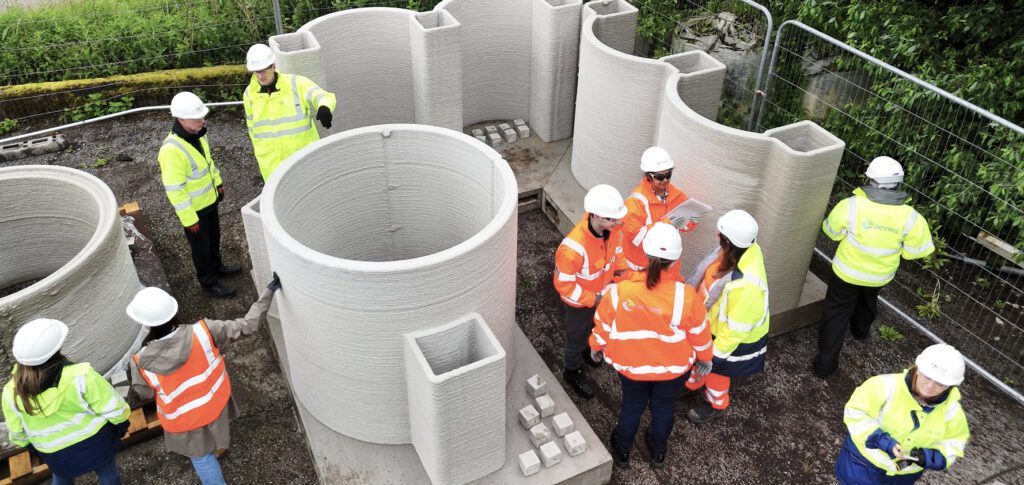
Three things I think commercial and finance teams should be looking at now:
- Understand the true unit cost.
Not simply £/m³ of printed concrete. Compare the complete installed asset: labour, materials, plant, logistics, preliminaries, programme and risk.
- Identify where repetition changes the economics.
The opportunity is unlikely to sit in replacing every traditionally constructed asset. It sits where there is sufficient volume, standardisation and pipeline visibility to drive utilisation and repeatability.
- Use AMP8 to build the evidence for AMP9.
If alternative delivery models are going to make a meaningful contribution in the next investment cycle, the commercial evidence, assurance and operating models need to be developed now.
The printer itself is only one part of the equation.
Utilisation matters. Standardisation matters. Material cost matters. Capital deployment matters. Pipeline certainty matters.
After more than two years looking at this from inside ChangeMaker 3D, what interests me most is that the questions we’re being asked are changing.
They are becoming less about whether concrete can be printed and increasingly about where the economics make sense and how the model scales.
For CFOs and Commercial Directors, I think that’s the useful conversation to have.
So my question is this: which repeatable assets in your AMP8 programme should you be analysing now, if you want a different cost base available to you for AMP9?
I’d be interested to hear how other finance and commercial leaders in the sector are approaching that question.
Aftab Rafiq
Chief Financial Officer
ChangeMaker 3D